|
A Sustainable Oregon
|
Is Accomplished by
|
|
Equal opportunity for all Oregonians
|
Putting average citizens first in all government actions
|
|
Maximize Oregonian's standard of living
|
Government encourages, rather than inhibits competition
|
|
Maximum access to plentiful jobs
|
Government that welcomes all non polluting industries
|
|
Fast and low cost transportation that is self financing
|
Ending government discrimination against cars.
|
|
Maximum opportunity for jobs creation
|
Limit regulations to those for safety and fraud prevention
|
|
Government based on sound principles and science
|
Outreach to ordinary people not special interests
|
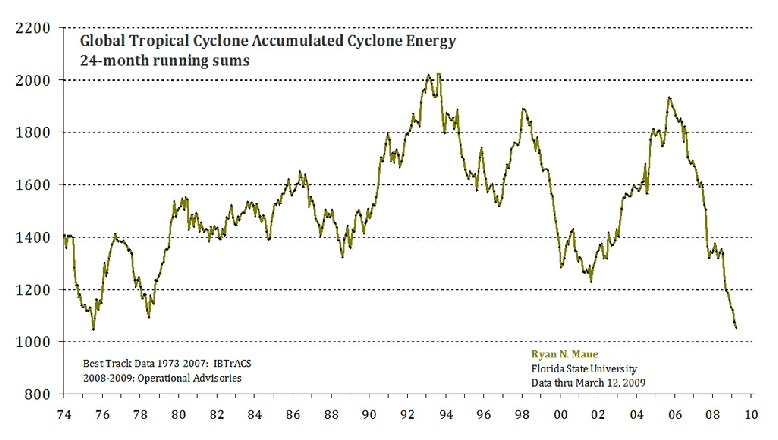
Figure: Global 24-month running sum time-series of Accumulated Cyclone Energy updated
through March 12, 2009.
Very important: global hurricane activity includes the 80-90 tropical cyclones that
develop around the world during a given calendar year, including the 12-15 that occur
in the North Atlantic (Gulf of Mexico and Caribbean included). The heightened activity
in the North Atlantic since 1995 is included in the data used to create this figure.
As previously reported here and here at Climate Audit, and chronicled at my Florida
State Global Hurricane Update page, both Northern Hemisphere and overall Global hurricane
activity has continued to sink to levels not seen since the 1970s. Even more astounding,
when the Southern Hemisphere hurricane data is analyzed to create a global value,
we see that Global Hurricane Energy has sunk to 30-year lows, at the least. Since
hurricane intensity and detection data is problematic as one goes back in time, when
reporting and observing practices were different than today, it is possible that
we underestimated global hurricane energy during the 1970s. See notes at bottom to
avoid terminology discombobulation.
Using a well-accepted metric called the Accumulated Cyclone Energy index or ACE for
short (Bell and Chelliah 2006), which has been used by Klotzbach (2006) and Emanuel
(2005) (PDI is analogous to ACE), and most recently by myself in Maue (2009), simple
analysis shows that 24-month running sums of global ACE or hurricane energy have
plummeted to levels not seen in 30 years. Why use 24-month running sums instead of
simply yearly values? Since a primary driver of the Earth's climate from year to
year is the El Nino Southern Oscillation (ENSO) acts on time scales on the order
of 2-7 years, and the fact that the bulk of the Southern Hemisphere hurricane season
occurs from October - March, a reasonable interpretation of global hurricane activity
requires a better metric than simply calendar year totals. The 24-month running sums
is analogous to the idea of "what have you done for me lately".
During the past 6 months, extending back to October of 2008 when the Southern Hemisphere
tropical season was gearing up, global ACE had crashed due to two consecutive years
of well-below average Northern Hemisphere hurricane activity. To avoid confusion,
I am not specifically addressing the North Atlantic, which was above normal in 2008
(in terms of ACE), but the hemisphere (and or globe) as a whole. The North Atlantic
only represents a 1/10 to 1/8 of global hurricane energy output on average but deservedly
so demands disproportionate media attention due to the devastating societal impacts
of recent major hurricane landfalls.
For the rest of the story: http://www.climateaudit.org/?p=5449
(from http://www.climateaudit.org/?p=5449)
by ryanm on March 12th, 2009
Post by Ryan N. Maue, Florida State University COAPS
Global hurricane activity has decreased to the lowest level in 30 years.