Debunking the Climate Scam
Billions of Dollars -
Greedy Green Corporations -
No Warming For Two decades -
Bought and Paid For Organizations

5000 Years Of Climate Change From Greenland Ice Cores

Study: Ocean net heat flow is connected with climate shifts – CO2 not correlated – no “warming in the pipeline”
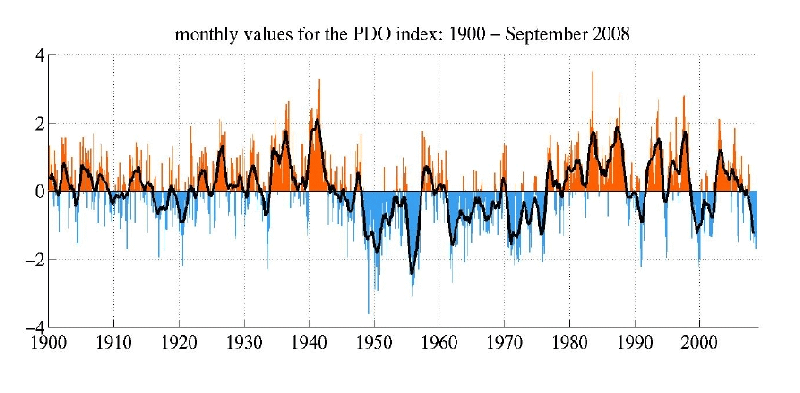
Related to this story: The Pacific Decadal Oscillation Time Series from the University of Washington, seen below. Emphasis points mine. h/t to WUWT reader Richard Heg. – Anthony
Monthly Values for the PDO Index, January 1900 to September 2008. Positive (red)
index values indicate a warm phase PDO; negative (blue) index values indicate a cool
phase PDO. While short-
Press release from the University of Rochester:
Changes in Net Flow of Ocean Heat Correlate with Past Climate Anomalies
Physicists at the University of Rochester have combed through data from satellites and ocean buoys and found evidence that in the last 50 years, the net flow of heat into and out of the oceans has changed direction three times.
These shifts in the balance of heat absorbed from the sun and radiated from the oceans correlate well with past anomalies that have been associated with abrupt shifts in the earth’s climate, say the researchers. These anomalies include changes in normal storm intensities, unusual land temperatures, and a large drop in salmon populations along the western United States.
The physicists also say these changes in ocean heat-
The study, which will appear in an upcoming issue of Physics Letters A, differs from most previous studies in two ways, the researchers say. First, the physicists look at the overall heat content of the Earth’s climate system, measuring the net balance of radiation from both the sun and Earth. And second, it analyzes more completely the data sets the researchers believe are of the highest quality, and not those that are less robust.
“These shifts happened relatively abruptly,” says David Douglass, professor of physics
at the University of Rochester, and co-
Douglass says the last oceanic shift occurred about 10 years ago, and that the oceans are currently emitting slightly more radiation than they are receiving.
The members of the team, which includes Robert Knox, emeritus professor of physics
at the University, believe these heat-
The team believes that the oceans may change how much they absorb and radiate depending on factors such as shifts in ocean currents that might change how the deep water and surface waters exchange heat. In addition to the correlation with strange global effects that some scientists suspect were caused by climate shifts, the team says their data shows the oceans are not continuously warming—a conclusion not consistent with the idea that the oceans may be harboring “warming in the pipeline.” Douglass further notes that the team found no correlation between the shifts and atmospheric carbon dioxide concentration.
“An interesting aspect of this research is that no reference to the surface temperature itself is needed,” says Knox. “The heat content data we used, gathered by oceanographers, was gleaned from temperature measurements at various ocean depths up to 750 meters.” The team also found that the radiative imbalance was sufficiently small that it was necessary to consider the effect of geothermal heating. Knox believes this is the first time this additional source of heat has been accounted for in such a model.
The team notes that it’s impossible to predict when another shift might occur, but
they suspect future shifts might be similar to the three observed. Both Douglass
and Knox are continuing to analyze various climate-
From: Watts Up With That blog
NASA: “The cold waters of Earth’s deep ocean have not warmed measurably since 2005,
according to a new NASA study”http://www.nasa.gov/press/2014/october/nasa-
Ocean heat increase Claim is really only 0.002 degree per year. See fig 5 here.
| Warming Stopped |
| NOAA Data |
| NorthWest |
| Oregon |
| Washington |
| Extreme Weather |
| Past Was Warmer |
| NASA: 30's Hotter |
| PastBeliefs |
| HistoryOFAlarmism |
| Central England |
| Temperature History |
| MultiProxy |
| treemometers |
| Northwest Passage |
| Acidification-Ball |
| Acidification-Fulks |
| Acidification-Idso |
| Selected Emails |
| CRU Emails - html formatted |
| CRU Emails Simple Format |
| CRU Emails UnFormatted |
| DCPS paper |
| CRU_Files_Notice |
| False Deadlines |
| Hockey Stick Links |