Debunking the Climate Scam
Billions of Dollars - Fudged Data - Corrupt Scientists
Greedy Green Corporations - Trillion Dollar Prize
No Warming For Two decades - Illiterate Media
Bought and Paid For Organizations
Introduction
We’ve been told that the earth’s surface is quite a bit warmer than calculations
predict. Theory has it that heat-trapping “greenhouse gases’ account for a 33 Celsius
disparity. But it turns out that our airless moon is also quite a bit warmer than
predicted. Might something be wrong with the prediction method itself, then? It’s
a natural question to ask, so let’s look into it.
The Theory
Climate science’s method of deriving a surface temperature from incoming radiant
energy (whose intensity is measured in watts per square meter) is based on the Stefan-Boltzmann
formula [1], which in turn refers to a theoretical surface known as a blackbody -
something that absorbs and emits all of the radiance it’s exposed to. Since by definition
a blackbody cannot emit less than 100% of what it absorbs, this fictional entity
has no option of drawing heat into itself, for that would compromise its temperature
response and thus its thermal emission. Its 100% thermal emission effectively means
that a blackbody is a two dimensional surface with no depth.
image
The pictures above illustrate how strange an actual blackbody would be. The purple
balloon has been converted to a blackbody, which is just as smooth as the real balloon
yet reflects no light from its surroundings - which is impossible because it’s nearly
as smooth as glass. Logically, then, this absolutely non-reflective balloon must
be infinitely rough - but once again it can’t be, because it is so smooth! In point
of fact, a real-life blackbody can only be approximated by a hole, a dark cavity
[2] that you can’t see into, which is not something we normally regard as a “surface”
to begin with. Treating the earth’s surface as a blackbody thus seems very problematic
from the start, yet this is the first assumption climate science makes when predicting
the earth’s temperature [3].
Moreover, the principal method for predicting a planet’s temperature is surprisingly
arbitrary and simplistic. On the premise that a sphere has 4 times the surface area
of a flat blackbody disc, the power of solar radiance on a sphere is assigned a value
4 times weaker [4]. In other words, if data indicate that one spot on your earth
model receives 956 watts per square meter at solar zenith, you just divide 956 by
4 to get 239, plug that into the Stefan-Boltzmann formula and obtain minus 18C, which
supposedly gives you an average temperature for the earth’s entire surface, regardless
of whether this model rotates or not. [5]
Is it any surprise, then, that even a relatively simple body like the moon would
refuse to conform to such a method?
Empirical reality
Since an “average temperature” method provides no information about day and night
temperatures within a particular zone, NASA scientists working on the Apollo project
had to employ a blackbody sun-angle model to chart the lunar surface temperatures
astronauts might encounter. Remember, a blackbody’s temperature always agrees with
the radiance it’s being exposed to. So, after taking albedo (reflectance) into account,
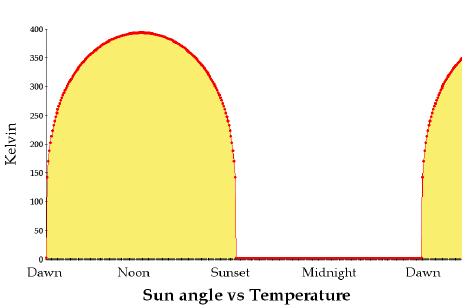
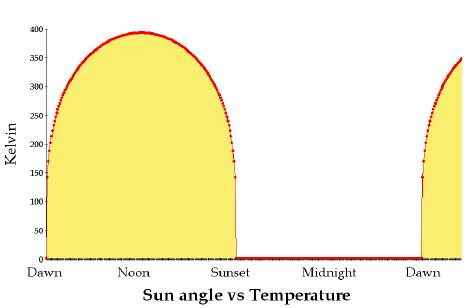
the temperature profile for a blackbody moon would look much like this (enlarged
here).
As you see, with the first glimpse of sunlight as lunar day commences, the blackbody’s
surface temperature rises and keeps rising till solar noon, after which the temperature
decline mirrors the rise. Having emitted 100% of its thermal energy at every step,
however, this imaginary surface has nothing in reserve to last the night, meaning
that a rotating blackbody surface theoretically remains at absolute zero for half
of the time.
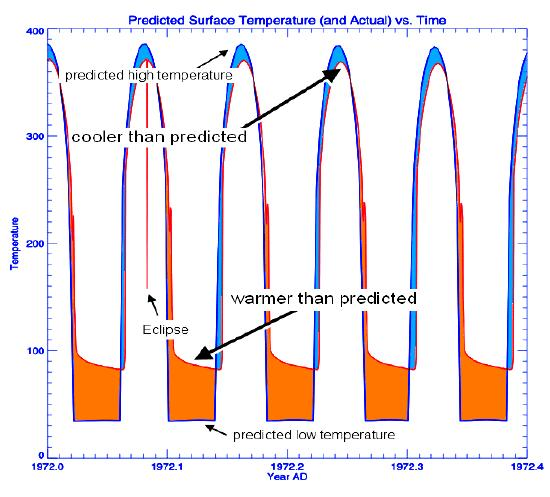
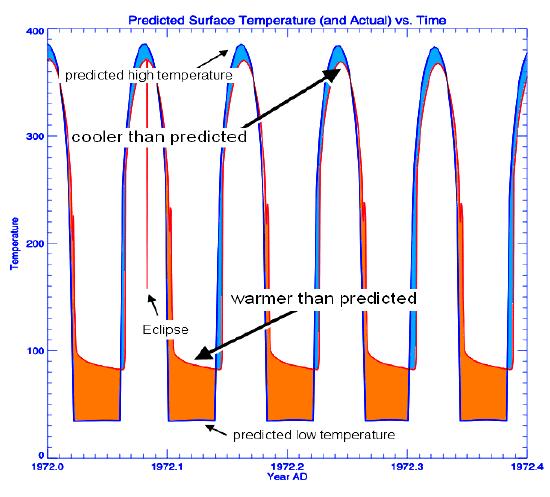
But now let’s look at what really happens(enlarged here). [6]
The filled-in blue and orange zones depict the deviation between observed and predicted
temperatures in the NASA experiments. Notice that the peak temperature actually occurs
sometime after solar noon. The projected low temperature didn’t plummet to zero in
this case because the radiative contribution of a “full earth” in the moon’s night-time
sky had been anticipated. As the chart and the study indicate, actual daytime lunar
temperatures were lower than expected because the real moon also conducts heat to
the inside rather than radiating all of it to space. Conversely, actual surface temperatures
throughout its two-week night were higher than expected because the moon “feeds on”
the heat it had previously absorbed. Thus (within the zone in question) the surface
of the real moon is roughly 20C cooler than predicted by day and 60C warmer by night,
the net result being a surface that is 40C warmer than predicted.